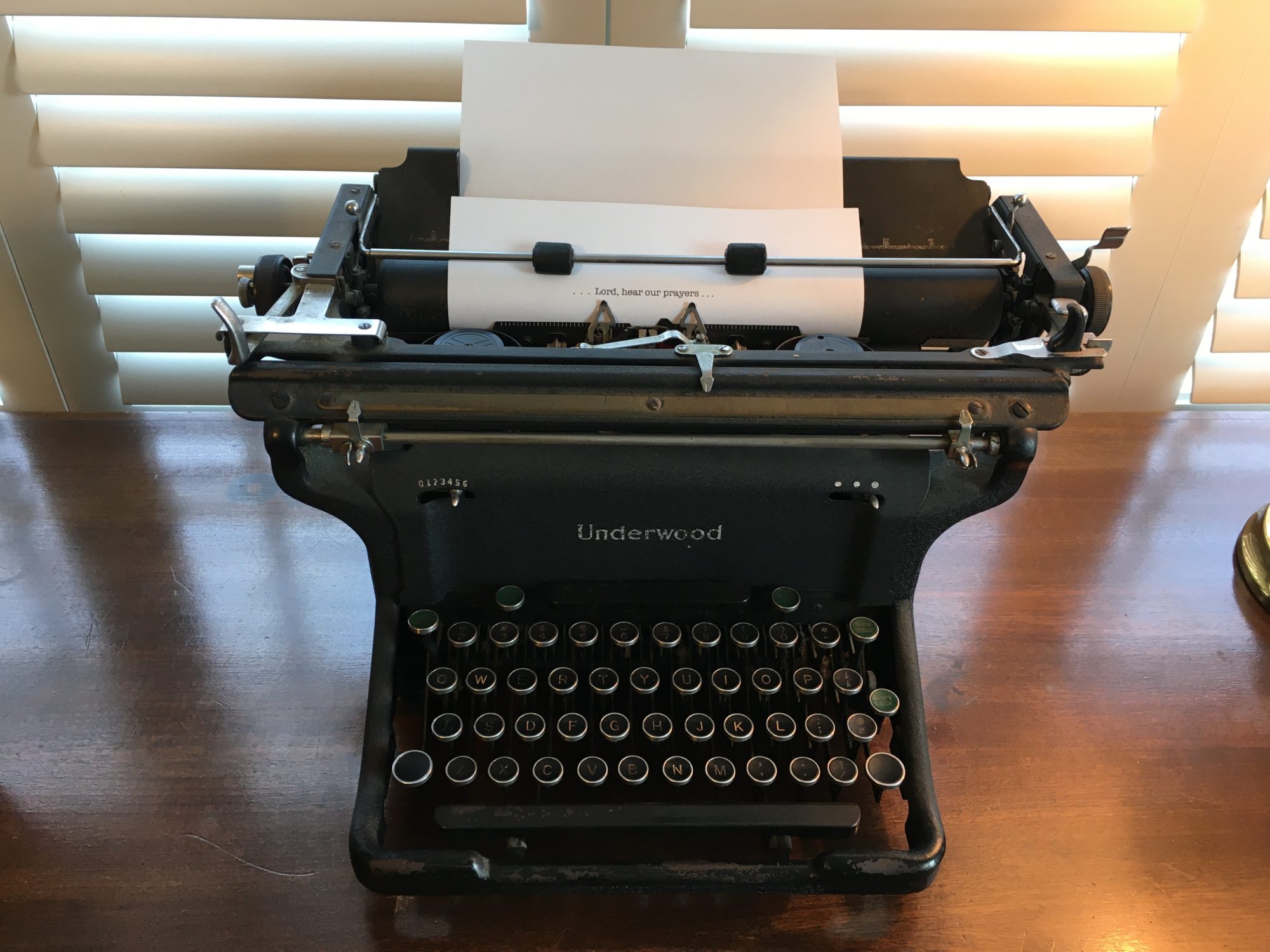
I’ve been thinking it’s time to report on the hymn writing workshop that was held at Wilshire on three Wednesday evenings in April. I was pleased to co-lead it with Doug Haney, who asked me to help plan it based on my recent dabbling in the genre.
Probably the best takeaway from the workshop is the discovery that we have some Wilshire members with a real talent for this sort of thing. I’m hoping that with further work and polishing you’ll be hearing some of their pieces in the months ahead. And I’m also hoping we’ve started a conversation that will continue and result in more musical offerings.
The highlight of the three-night class for me was hearing and learning from Brian Hehn, director of the Center for Congregational Song, a branch or spinoff of The Hymn Society. The organization promotes church music in all its different forms across all denominations and cultures, and Hehn is an enthusiastic, talented and immensely knowledgeable resource. His central message was that church music is as relevant and important to worship as it has ever been, but church music today covers a wide spectrum of styles and forms. Are hymns still important and widely used? Yes. Will hymns be the majority of what is used? No, but nothing else will be either. Church music is as segmented today as the radio dial and the digital television guide.
Hehn says there is a time and place for all the different styles of church music that we may encounter, and we do experience that at Wilshire on a regular basis. We call our worship “traditional,” and while in the larger church world that has come to indicate a style of music, at Wilshire the label speaks more to the structure of our worship. We follow a liturgy that is traditional and perhaps even “high church.” And while we do favor organ-accompanied hymns out of the thick, green “Celebrating Grace” hymnals in the pew racks, we make ample room for every imaginable style of music. We hear gospel, bluegrass and folk; contemporary, ballad and jazz; Caribbean, African and Latin; solos and anthems; hymns with verses and refrains, and psalms with congregational responses. Sometimes there’ll be several of those styles in the same service, but all will be placed in the context of our traditionally structured worship.
I’ve always contended that I can appreciate and enjoy in any style of music if it is good, if it is done well, and that goes for worship music. I’m not especially fond of so-called “praise music” but I’m not sure why. After all, I grew up in the 1970s when we were “passing on” that “sweet, sweet spirit” to tell the world “he’s everything to me.” And I stood in the youth choir and sang the soundtrack to “Godspell” with “Bless the Lord” and “Day By Day” and “Save the People.” I thought it was good music then and it still tickles my nostalgic ear, but it’s as dated as a tie-dyed shirt and probably not what we want to sing at Wilshire today.
If there is a line to be drawn in the sand when it comes to worship music, it’s in front of music that just doesn’t work. We talked about that in the workshop, and that can include hymns that simply are not sing-able by a congregation or that are “bad marriages” of texts and melodies. Some of that is subjective, but usually you will know it when you hear it – or when you try to sing it but can’t.
And I’m sorry but I also draw a line at Christian rock. That’s not because I don’t like rock; I have a list of concerts I’ve attended that includes some of the biggest names from the golden age. But as animated television dad Hank Hill once said to a Christian rock musician: “Can’t you see you’re not making Christianity better; you’re just making rock and roll worse.”
Do I hear an amen?